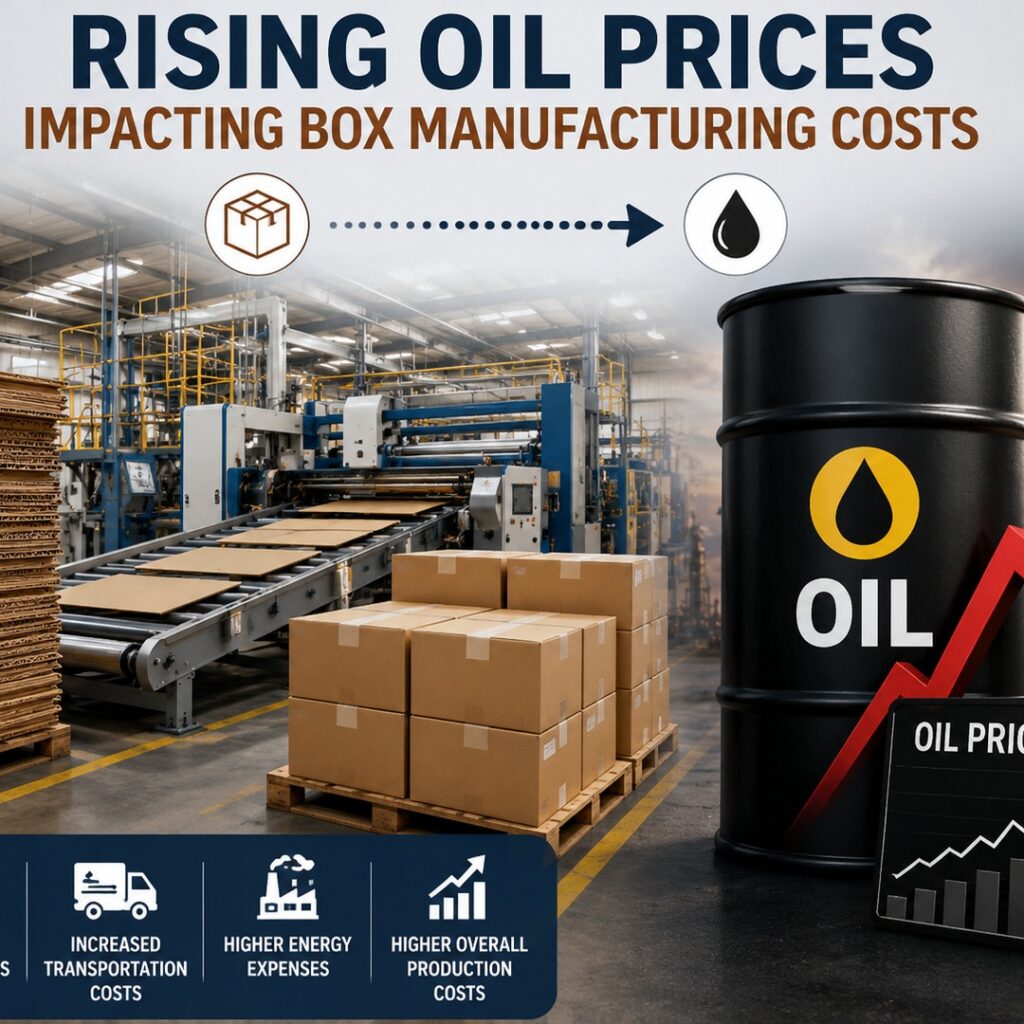
Packaging Price Increases 2025: Why Cardboard Boxes, Tape, Stretch Wrap & Refuse Sacks Are Costing More — And What UK Businesses Can Do About It
Published by Office Packaging | Packaging Industry NewsIf you’ve noticed your packaging invoices creeping upward over the past few months, you’re not alone. Businesses across the UK are seeing significant price increases on everything from cardboard boxes and rigid mailers to pallet stretch wrap, adhesive tape and refuse sacks. The root cause runs deeper than a simple supply-chain hiccup — it traces back to sustained instability in the Middle East, rising crude oil prices, and the knock-on effect those energy costs have on virtually every material used in modern packaging manufacturing.In this post, we break down exactly why prices are rising, which packaging products are most affected, and what steps your business can take right now to manage costs without disrupting your operations.
The Middle East Crisis and the Oil Price Ripple Effect on UK Packaging
Crude oil is the invisible ingredient in almost everything you pack, wrap or ship. Ongoing conflict and geopolitical tension in the Middle East has squeezed global oil supply, pushing Brent crude prices to levels that cascade through energy-intensive manufacturing industries — packaging being one of the hardest hit.Here’s how the chain reaction works:
Higher petrochemical costs → increased cost of raw plastic resins (LDPE, LLDPE, polypropylene)
More expensive plastic resins → higher manufacturing cost for tape, stretch wrap, shrink film and refuse sacks
Higher energy prices → increased cost to run paper mills and corrugated board production lines
Mill cost increases → more expensive corrugated cardboard, cardboard boxes, rigid mailers and bookwraps
No packaging category sits outside this chain. Whether a product is made from virgin plastic or recycled corrugated fibre, energy cost underpins every stage of its production, transportation and distribution.
Standard polypropylene (PP) and PVC packaging tapes are manufactured almost entirely from oil-derived materials — from the film backing to the adhesive compound. When crude oil prices spike, tape manufacturers face a simultaneous increase in raw material costs and energy overheads. The result is price increases being passed down the supply chain to distributors and end-users across the UK.What this means for you: Standard brown parcel tape, clear tape, fragile tape and specialist printed tape are all subject to ongoing price pressure in 2025. Buying in bulk where you have the storage capacity remains one of the most effective ways to lock in a lower price per roll.👉 Browse our full range of packaging tape
Pallet Stretch Wrap
Pallet stretch wrap — also known as pallet wrap or stretch film — is made from Linear Low-Density Polyethylene (LLDPE), a plastic resin derived directly from crude oil processing. It is one of the packaging materials most acutely sensitive to oil price movements. As LLDPE resin costs have increased sharply alongside the oil price, UK distributors and logistics operations are seeing meaningful increases on both hand stretch wrap and machine stretch wrap.What this means for you: If your business palletises and ships goods regularly, now is a good time to audit how much stretch wrap you’re using per pallet and whether a higher-gauge, higher-performance film could reduce consumption — often cutting total spend despite a higher unit price.👉 View our pallet stretch wrap range
Refuse Sacks & Bin Liners
Heavy-duty refuse sacks — whether used in offices, warehouses or retail environments — are manufactured from high-density or low-density polyethylene (HDPE/LDPE). Both are petrochemical products, and both have seen significant raw material cost increases. Combine that with higher energy costs at the manufacturing plants, and refuse sack prices have risen considerably across the UK market in 2025.👉 Shop refuse sacks & bin liners
You might assume that cardboard — a paper-based, renewable material — would be insulated from oil price shocks. In reality, the paper and corrugated board industry is one of the most energy-intensive sectors in UK manufacturing. Paper mills consume vast quantities of electricity and gas to power pulping, drying and pressing processes. When wholesale energy prices rise alongside oil, mill operating costs climb sharply — and those costs flow directly into the price of every cardboard product you buy.
Cardboard Boxes (Corrugated & Single Wall)
Corrugated cardboard boxes are the backbone of e-commerce and commercial shipping across the UK. The corrugated medium — the wavy inner layer of board — requires enormous amounts of energy to produce. Higher energy costs, combined with elevated demand from ongoing e-commerce growth, have created sustained upward price pressure on single wall, double wall and triple wall cardboard boxes throughout 2025.👉 Browse cardboard boxes — all sizes
Rigid card mailers — the stiffened envelopes used for sending documents, photographs, prints and rigid items through the post — have seen some of the steepest proportional increases. The rigid card used in their construction is a higher-grade board product, manufactured with more energy-intensive processes than standard corrugated board. As energy and raw material costs have risen, rigid mailer prices have followed suit.For businesses shipping high volumes of A4, A5 or A3 rigid mailers through Royal Mail or couriers, even a modest per-unit price increase compounds significantly at scale.👉 Shop rigid mailers & board-backed envelopes
Bookwraps & Wraparound Mailers
Bookwraps — self-locking corrugated mailers widely used by booksellers, e-tailers and fulfilment centres — are a corrugated product and therefore directly subject to the same board cost pressures affecting standard cardboard boxes. Their more complex die-cut construction also involves additional manufacturing steps, meaning overhead increases are felt proportionally more than in simpler box formats.👉 View bookwraps & wraparound mailers
How UK Businesses Can Manage Packaging Cost Increases in 2025
Price increases driven by global commodity markets are largely outside any one business’s control. What you can control is how strategically you purchase and consume packaging materials. Here are our top recommendations:
1. Buy in Bulk Where Storage Allows
Locking in today’s price on high-volume consumables — such as tape, stretch wrap and refuse sacks — protects you against further increases. Even a modest buffer stock can save meaningful amounts if prices continue to rise quarter on quarter.
2. Audit Your Packaging Consumption
Are you consistently over-boxing? Using more stretch film than necessary per pallet? A simple consumption audit often reveals 10–20% savings through right-sizing and better operator habits — without changing supplier or specification.
3. Consider Performance-Grade Alternatives
Higher-performance packaging products — thinner but stronger stretch films, higher-yield tape rolls, or lighter-weight corrugated grades — can reduce the quantity of material used per shipment. In a rising cost environment, a slightly higher unit price with significantly better yield can reduce your total packaging spend.
4. Consolidate Your Supplier
Spreading packaging purchases across multiple suppliers often means paying higher prices and missing volume-tier discounts. Consolidating with a single trusted UK supplier gives you better pricing leverage and simplifies your procurement process.
5. Talk to Your Packaging Supplier Now
If you haven’t had a conversation with your packaging supplier about forward pricing, volume agreements or alternative specifications, now is the time. Proactive businesses that plan ahead are better placed than those who react to price increase notices after the fact.
What to Expect from Packaging Prices for the Rest of 2025
Market analysts and packaging industry bodies have signalled that price pressure is unlikely to ease significantly in the near term. With Middle East tensions showing no clear resolution and global demand for packaging materials remaining robust, the factors driving current price increases remain firmly in place.UK packaging manufacturers and distributors are continuing to absorb cost increases where possible, but the scale of input cost rises means further price adjustments across plastic and paper-based packaging products remain likely through 2025 and into 2026.The best protection for your business is purchasing strategically, consuming efficiently, and working with a reliable UK supplier who is transparent about market conditions and cost drivers.
Get the Best Value on UK Packaging — Talk to Office Packaging Today
Frequently Asked Questions About UK Packaging Price Increases
Why are cardboard box prices increasing in the UK in 2025?
Cardboard box prices are rising primarily because of higher energy costs at paper mills and corrugated board manufacturers. Energy is the single largest cost input in corrugated board production, and elevated wholesale gas and electricity prices — themselves linked to global oil market instability — are being passed through the supply chain.
Why is pallet stretch wrap getting more expensive?
Pallet stretch wrap is made from LLDPE (Linear Low-Density Polyethylene), a plastic derived from crude oil. As oil prices have risen due to Middle East tensions, the cost of LLDPE resin has increased sharply, directly raising the manufacturing cost — and selling price — of stretch wrap across the UK market.
Are rigid mailer prices increasing too?
Yes. Rigid card mailers use a higher-grade board product that requires energy-intensive manufacturing. Both the raw board cost and the manufacturing overhead have risen in 2025, making rigid mailers one of the packaging categories most affected by current market conditions.
How long will packaging price increases last?
The timeline depends on how quickly Middle East tensions ease and whether global energy markets stabilise. Industry forecasts suggest continued pressure through 2025, with limited prospect of significant price reductions in the near term. Businesses should plan purchasing strategies on the assumption that current prices represent the new baseline.
What can I do to reduce my packaging costs?
Key strategies include buying in volume to lock in current prices, auditing packaging consumption to eliminate waste, considering higher-performance products with better yield, and consolidating purchasing with a single reliable supplier for volume discounts. Speaking to your packaging supplier for tailored advice is always a good first step. >


 Cardboard
  Postal &
  Protective
  Rigid & Bubble
  Bags &
  Packing
  Polythene
  Paper
Paper  Address
  Pallet
  Other
Other